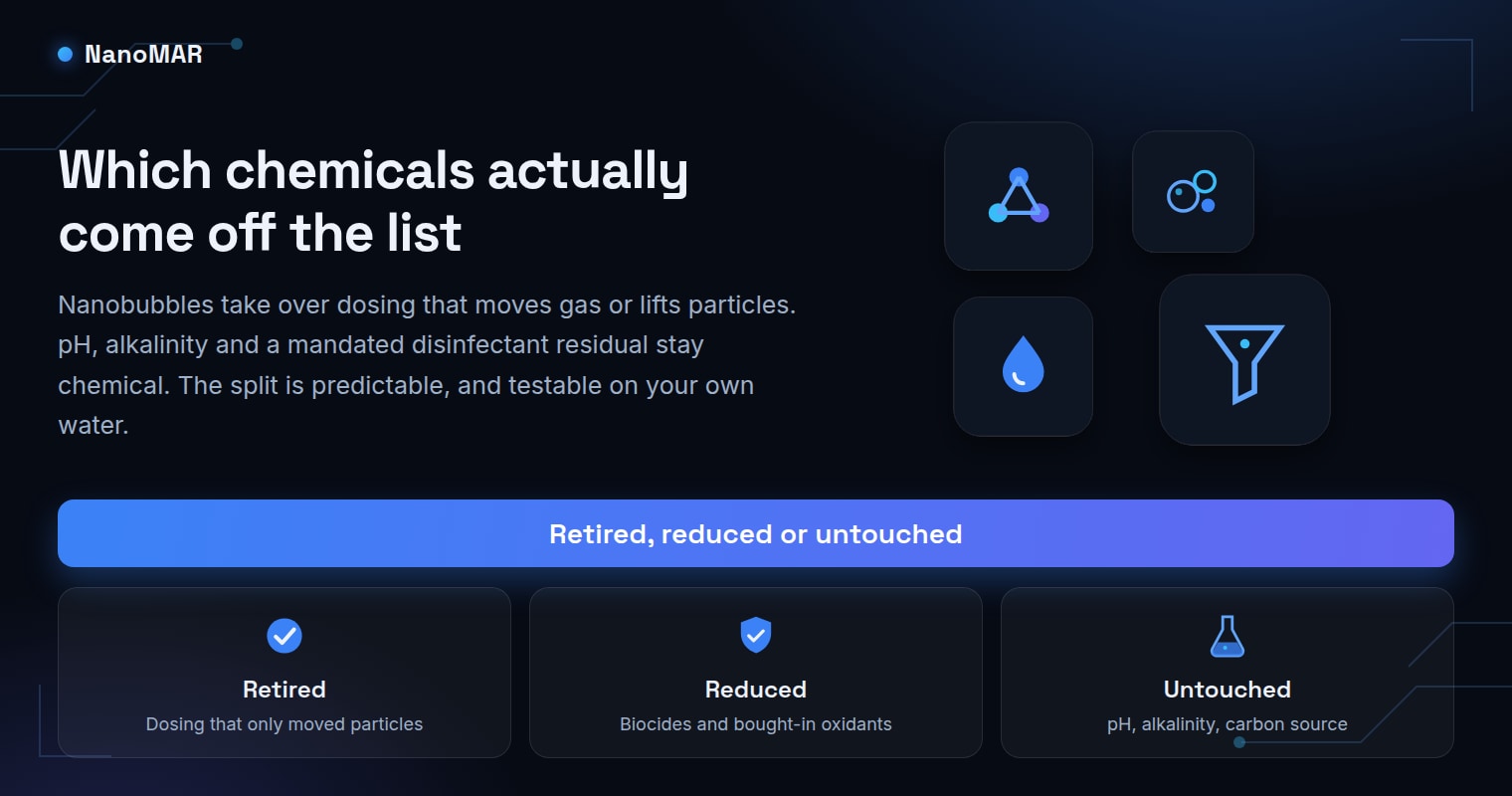
Walk past the chemical store on a water treatment plant and the pallet labels tell you what that plant actually believes. So does nanobubble technology replace or reduce chemicals? It reduces them far more often than it removes them, and the split is predictable. Where a chemical is dosed to move gas into water or to lift particles out of it, a nanobubble stage can take the duty over. Where it is dosed to change the chemistry of the water itself, a gas cavity under 200 nm does nothing at all.
NanoMAR builds patented nanobubble systems in Bergen, so the second half of that answer costs us arguments. It gets written anyway, because the alternative is an operator who cancels a bicarbonate order and finds out in week three. The case for chemical-free water treatment is made elsewhere; this piece does the sorting.
Which dosed chemicals can nanobubbles actually retire?
The ones whose job is physical. A nanobubble is a gas-filled cavity under 200 nm, effectively neutrally buoyant, which is why it stays suspended for days to weeks rather than rising and bursting in seconds. It carries a strong negative zeta potential, and that charge is what lifts suspended contaminants. Nothing is added to the water, so there are no by-products or residues waiting downstream. For its own platform NanoMAR publishes 80 %+ suspended-matter removal, 50 %+ turbidity reduction and 40 %+ higher oxygen transfer.
Read your dosing list against that mechanism and it sorts into three piles.
| Dosed product and its duty | What a nanobubble stage changes | Realistic verdict |
|---|---|---|
| Coagulant or flocculant aid, dosed to get suspended solids out | Surface charge and flotation separate the solids, with nothing added | Often retired on the right water, otherwise reduced |
| Biocide against biofilm in tanks, pipework and cooling loops | Ozone or oxygen nanobubbles work on the film; fewer cleaning cycles where biofilm is controlled | Usually reduced, sometimes retired |
| Oxidant bought in drums and delivered to site | Ozone is generated where it is used, so storage and deliveries fall away | The purchase goes, the oxidant chemistry stays |
| Cleaning and degreasing agents on surfaces and equipment | Surface cleaning is one of the duties the platform is built for | Reduced, test surface by surface |
| Base dosed to hold pH and alkalinity | Nothing. Gas transfer does not manufacture bicarbonate | Untouched |
| Carbon source dosed for denitrification | Nothing. Those bacteria need electrons, not oxygen | Untouched |
Where does nanobubble technology reduce chemicals rather than replace them?
In most plants, because most chemicals are quietly doing two jobs at once. A coagulant bought for turbidity is also holding a filter run together; a biocide bought for biofilm is also covering a dead leg nobody wants to repipe. Take the physical half of the duty away and the dose falls, but the product stays on the order list.
The research literature lands in the same place, which is worth hearing from outside a supplier's website. A 2025 review of micro and nanobubbles in Frontiers in Environmental Science concludes that "the single MNB technology cannot be put into practical large-scale use yet", and describes a field moving towards combinations with ozone and other processes. A bubble is a carrier and a separator. A plant is a chain of duties.
Ozone shows the pattern plainly. Generating it on site through a membrane, venturi or ceramic stage removes the purchase order, the storage tank and the deliveries. It does not remove the oxidant: off-gas handling, materials compatibility and contact time still have to be engineered. Water treatment without chemicals is then a fair description of the water, not of the plant room.
What can a 200 nm bubble never do?
It cannot supply an ion. That sentence covers most of the third pile, and in a recirculating fish farm it covers the dosing that matters most. Nitrification eats alkalinity continuously, and a DTU Aqua study on pilot-scale RAS notes that alkalinity below 100 mg CaCO₃ per litre has been shown to reduce nitrification capacity. Oxygen transfer, however good, puts no carbonate back.
Neither can it feed a process that runs on carbon. The same DTU case study dosed carbon into pilot RAS with trout and found that acetate addition brought biofloc formation, a significant rise in bacterial activity and turbidity, and fish growth reduced by 7.4 to 20 % against the controls. Dosed chemistry has consequences a gas stage can neither cause nor cure.
The third limit is regulatory. Where a rule requires a disinfectant residual to travel through a network, something has to be in the water to carry it, and the US EPA's Stage 1 and Stage 2 Disinfectants and Disinfection Byproducts Rules cover the systems that deliver one. NanoMAR builds process water systems and makes no drinking-water claim. Where a residual is mandated, nanobubbles belong upstream of it, lowering the load the disinfectant has to meet.
How do you prove the split on your own water?
Nobody settles the replace-or-reduce question from a brochure, this one included. The answer lives in your water.
- Baseline the dose you actually pay for, per cubic metre treated, over a stretch of normal running long enough to include one bad week.
- Pick one duty. A trial that moves three chemicals at once tells you nothing about any of them.
- Keep the dosing line able to come back within a shift. A pilot that cannot be reversed is not a pilot.
- Measure the parameter the chemical was bought for. Dissolved oxygen is the easy number and often not the question.
- Agree the stop rule in writing before start-up, and count what else leaves with the chemical: storage, handling, protective equipment, sludge volume.
One caveat belongs here. NanoMAR has no published reference installations, and that counts against us when you compare suppliers. What exists is a platform built around four process stages and a documented way of running a pilot, with the measurements agreed before it starts.
Frequently asked questions
Does nanobubble technology replace chemicals completely?
Rarely, and NanoMAR does not promise it. Nanobubbles replace dosing whose job is gas transfer or separating particles, because a cavity under 200 nm carries a negative surface charge and nothing is added to the water. Dosing that corrects pH, alkalinity or hardness stays, since physics cannot supply those ions.
Which chemicals do nanobubbles usually reduce rather than remove?
Coagulants and flocculant aids used for solids removal, biocides dosed against biofilm, and oxidants bought in drums where ozone can instead be generated on site. For its nanobubble platform NanoMAR publishes 80 %+ suspended-matter removal and 50 %+ turbidity reduction, achieved with nothing dosed and no residues left behind.
How do you test whether nanobubbles can cut chemical dosing?
Run one duty at a time on your own water, and keep the existing dosing line able to come back within a shift. Measure the parameter the chemical was bought for, not only dissolved oxygen. Because NanoMAR has no published reference installations, a pilot with a stop rule agreed in advance is the evidence that counts.
What I learned the hard way is that almost nobody on a plant can tell you what a chemical is really for. Most of my work has been RAS water quality and design optimisation, and early on I read the dosing line off the P&ID and treated it as settled. Wrong. On one project I asked why a dose had been raised months earlier and got three answers: the operator said turbidity, the log said a smell complaint, and the person who ordered the drums said it had never been turned back down after a bad spell. None of that was in the design basis. So before I argue that physics can replace anything, I go and find out why the dose sits where it sits. Slow conversation. It has changed my own recommendation more than once.
If you want this split worked out for your plant rather than in general, send the duty, a water analysis and the dose you are paying for today, and we can go through what a pilot would have to prove.
Sources
- Research progress of micro-nano-bubbles in environmental remediation field — Frontiers in Environmental Science, Chen et al., 2025
- A case study comparing the addition of two different carbon sources in pilot scale RAS with trout with and without biofilters — Aquacultural Engineering, Gregersen & Pedersen, 2023, via DTU Orbit
- Stage 1 and Stage 2 Disinfectants and Disinfection Byproducts Rules — US Environmental Protection Agency