Advanced aquaculture system
NanOxy Pro
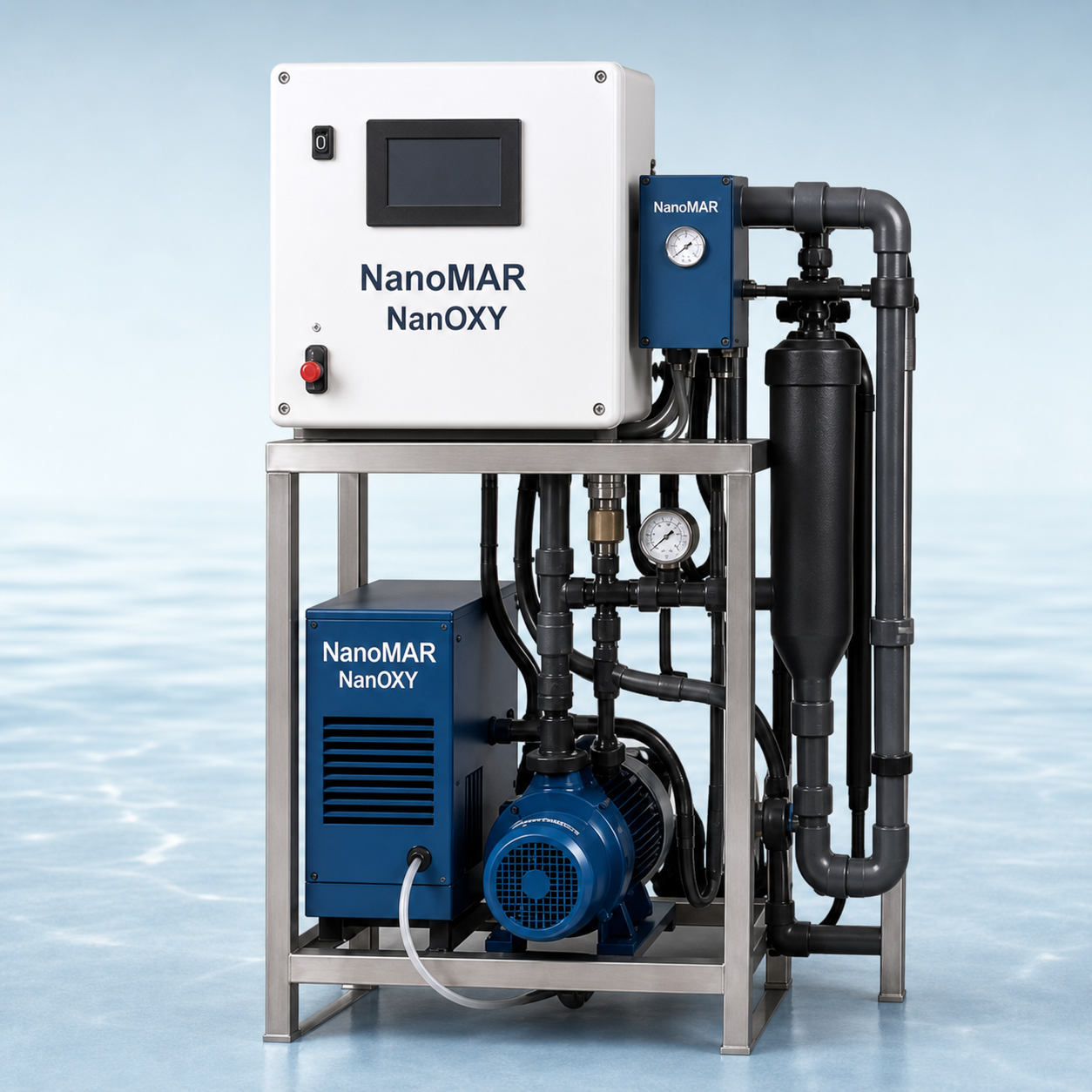
A skid-mounted nanobubble generator engineered for continuous aquaculture duty, precise dissolved-oxygen control and improved water quality.
18.9–75.6 m³/h
At a glance
- 18.9 m³/h at 40 mg/L
- 37.8 m³/h at 20 mg/L
- 75.6 m³/h at 10 mg/L
- Approx. 200 kg
Capacity and performance
The NanOxy Pro is a skid-mounted nanobubble generator from NanoMAR in Bergen, rated 18.9–75.6 m³/h. Its three duty points are one machine, not three: gas delivered per hour is fixed, so flow and concentration trade against each other.
Which duty point should you specify?
Specify 40 mg/L to close a deficit through a small side stream; specify 10 mg/L when the job is contact across a large volume. Pick on flow alone and you buy the wrong machine.
So work the gas budget before the flow rate. Our oxygen transfer efficiency calculator turns respiration, biofilter demand and degassing losses into a duty point; what a system costs follows from that duty point.
Technical specifications
Three separation technologies sit on one platform — membrane, venturi and ceramic — because no single shear stage suits every water. Membrane is most repeatable on clean water; venturi takes dirtier water at higher throughput; ceramic survives abrasion.
All three produce cavities under 200 nm carrying a strong negative zeta potential. The charge lifts contaminants; near-neutral buoyancy keeps them suspended for days to weeks, so gas transfers far downstream of the skid. Nothing is dosed, so no residue follows. Every other model in the range shares this stage.
Gas options: O2, air, ozone
The skid does not care which gas you feed it. The process does, and that choice outlives the machine.
Oxygen
The feed when biology is the load. Highest dissolved concentration, but it commits you to a generator, a tank or a contract.
Air
Nothing to buy, store or permit. A lower ceiling on dissolved oxygen, enough wherever the deficit is shallow.
Ozone
Disinfection rather than oxygenation. The oxidant reaches the biofilm and leaves no chemical residue.
Typical applications
Continuous aquaculture is the design duty. The same skid is specified for these jobs elsewhere.
| Duty | Gas | What it does |
|---|---|---|
| Oxygenation and aeration | Oxygen or air | Holds a setpoint against respiration and biofilter demand, at 40 %+ higher transfer |
| Disinfection and pathogen control | Ozone | Cuts pathogen pressure without dosing a chemical |
| Algae and biofilm control | Ozone or oxygen | Keeps surfaces clear between cleanings |
| Flotation and separation | Air or oxygen | Floats fine solids: 80 %+ suspended-matter removal, 50 %+ turbidity reduction |
| Odour and sludge reduction | Oxygen | Keeps a sump aerobic instead of septic |
Also wastewater, food, mining, lakes and ponds, and desalination.
Installation and integration
The generation stage arrives assembled. The project work is the tie-in.
-
01
Take a side stream, not the main flow
The skid can then be serviced while the process runs.
-
02
Confirm the gas supply first
That, not the generator, is usually the long pole.
-
03
Plan the footprint and the lift
At roughly 200 kg it wants a levelled base and access.
-
04
Put control where operators already look
Probe position decides what the loop actually holds.
-
05
Baseline before commissioning
Log oxygen, turbidity and solids before start-up.
Energy use
Compare generators on energy per kilogram of gas actually transferred, not on motor rating. Venting half your gas at the surface costs more than drawing more power.
A coarse bubble loses most of its gas through the water surface. Nanobubbles stay in suspension, so transfer approaches completion: NanoMAR's published figure is 40 %+ higher oxygen transfer. Lower energy follows from buying less gas for the same concentration. We publish no percentage, because an honest one depends on what you are replacing. How we would prove it on your water is set out under how we measure and report.
Download datasheet
The datasheet is issued against a duty point rather than posted as a generic PDF, because half of what matters depends on your water. Tell us the duty and we will send it.
Frequently asked questions
- What flow rate does the NanOxy Pro deliver?
NanoMAR's NanOxy Pro delivers 18.9 m³/h at 40 mg/L, 37.8 m³/h at 20 mg/L, or 75.6 m³/h at 10 mg/L. Gas delivered per hour stays the same, so flow and concentration trade against each other.
- Which gases can the NanOxy Pro run on?
Oxygen, air or ozone. NanoMAR specifies oxygen where biology is the load, air where the deficit is shallow, ozone where the duty is disinfection.
- Is the NanOxy Pro suitable for a recirculating aquaculture system?
Yes — continuous aquaculture is the design duty. NanoMAR installs it on a side stream off a pumped RAS loop, where it holds a dissolved-oxygen setpoint at 40 %+ higher transfer.
- Where is the NanOxy Pro built?
NanoMAR AS builds the NanOxy Pro in Bergen, Norway, and was founded there in 2023. Get in touch from anywhere in Europe and you speak to the engineer who sizes your duty point.
Request a quote
Send your flow, your target concentration and what the water is doing today. Our engineers in Bergen return a duty point, a separation stage and a comparable specification.
Specifications
| Flow range | 18.9–75.6 m³/h |
| Bubble size | < 200 nm |
| Gas options | Oxygen · Air · Ozone |
| Separation stages | Membrane · Venturi · Ceramic |
| Operation | Continuous, automated |
| Chemicals | None required |
Ready to rethink your water?
Tell us about your process and we'll size a nanobubble system for it.
Talk to our team