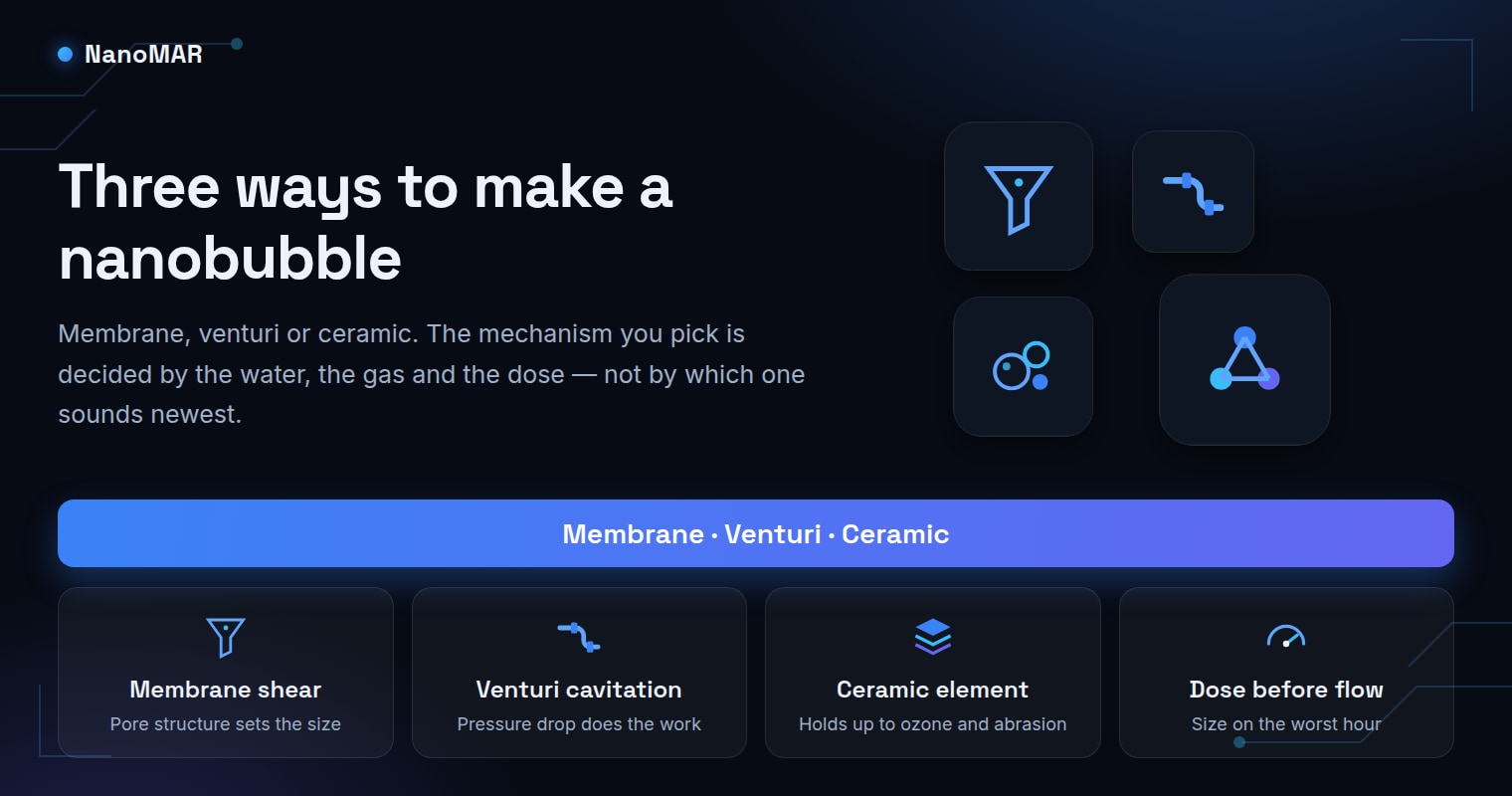
To generate nanobubbles you push gas into water and break the gas–liquid interface hard enough that what survives is a cavity under 200 nm — small enough to stop behaving like a bubble at all. Three mechanisms do that at working scale: a membrane, a venturi, and a ceramic element driven by cavitation. NanoMAR runs all three on one patented platform. Knowing how to generate nanobubbles matters far less than knowing which of the three suits the water in front of you.
What has to be true before a bubble counts as a nanobubble?
Size is the whole argument. The terminology standard for the field, ISO 20480-1:2017, groups every bubble below 100 µm as a fine bubble and splits that group in two: microbubbles from 1 µm upwards, and ultrafine bubbles below 1 µm. The committee behind it avoids the word "nanobubble" entirely, because "nano" already carries a stricter meaning in ISO's nanotechnology vocabulary — 100 nm or less. NanoMAR's own specification sits well inside the ultrafine class, at under 200 nm.
Below that size the behaviour changes completely. A coarse bubble rises and bursts in seconds. A nanobubble is effectively neutrally buoyant and stays suspended for days to weeks, carrying a strong negative zeta potential that repels its neighbours and lifts contaminants off surfaces; the persistence of bulk nanobubbles in water is well documented in the laboratory literature. The combined gas–liquid interface across a whole population of them is enormous, and that is what drives near-complete gas transfer instead of gas escaping at the surface.
How do you generate nanobubbles with a membrane?
Gas is delivered under pressure to one side of a fine-pore membrane while water flows across the other. The cross-flow shears each forming bubble off the pore before it can grow, so size is set by the pore structure and the flow across it rather than by how violently the water is treated. That makes it the most controllable of the three methods, and the most demanding about feed quality — a membrane surface fouls if the water is dirty.
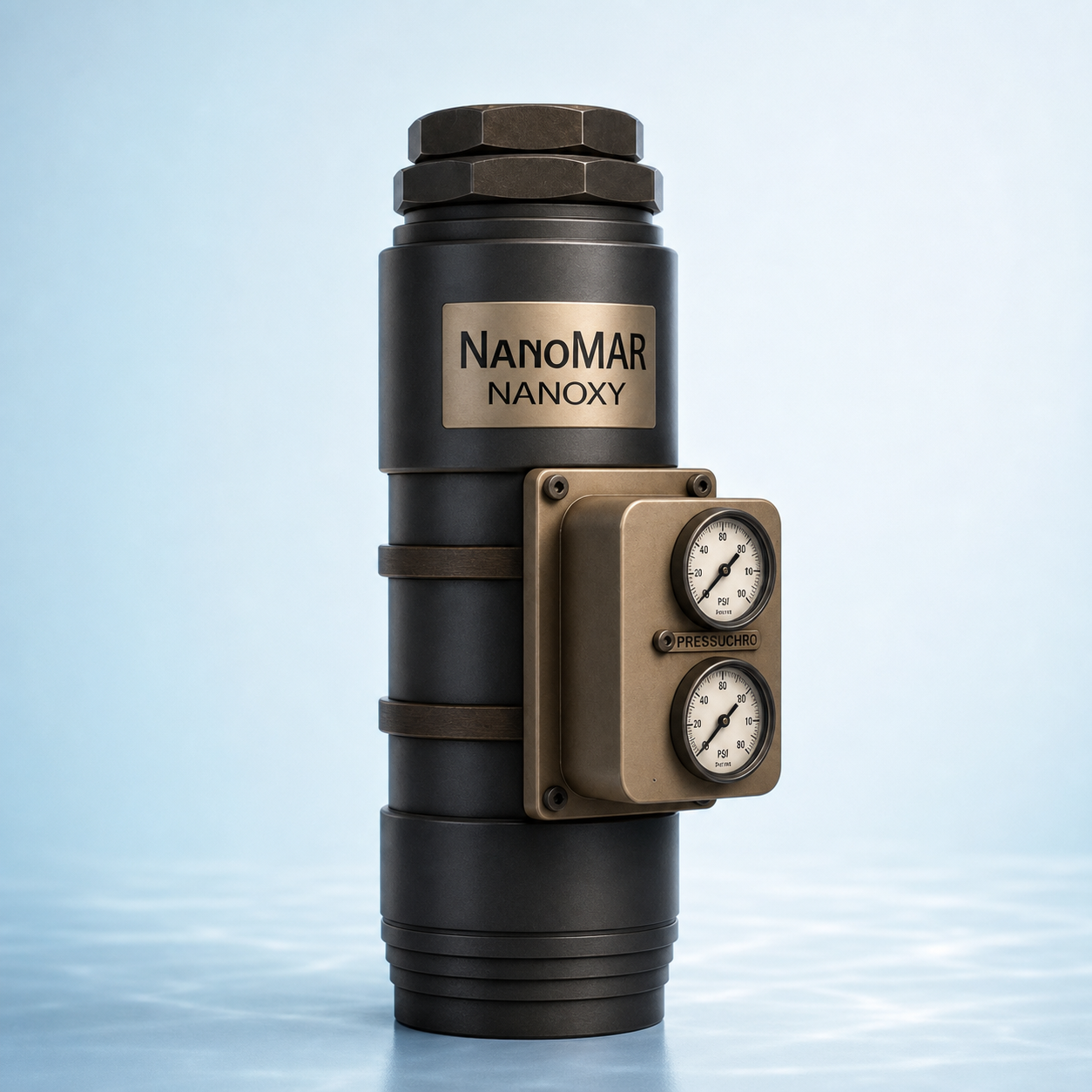
Two details of NanoMAR's membrane units matter when you plan the installation. The NanOxy S1 membrane platform covers 0.3–1 000 m³/h, the widest span in the range, from a laboratory bench to a full industrial line. It needs a compressed gas supply, and it has no electrical connection at the membrane module itself — which quietly simplifies siting in a wet room. The portable NanOxy S2 sits at 2–50 lpm for oxygenation trials and repeatable R&D validation.
What does a venturi actually do to the gas?
A venturi has no moving parts and no membrane surface to protect. Water accelerates through a constriction, static pressure falls, and gas is drawn into a stream already travelling fast. Past the throat the section opens out, pressure recovers, and the combination of shear and local cavitation tears the entrained gas into a fine population. Nothing in that path is easily blinded by solids, which is why venturi injection survives raw water that would foul a membrane within a shift.
The trade-off is control. Bubble size follows the pressure differential across the throat, so a venturi rewards a stable duty point and punishes a loop whose flow wanders all day.
Where do ceramic elements and cavitation fit in?
A ceramic element works on the same principle as the membrane — gas through a controlled pore structure — but in a material that shrugs off abrasion, temperature swings and oxidising gas. That last point is the practical one. Ozone attacks most polymers, so where the duty is disinfection rather than oxygenation, the material of the generation stage stops being an implementation detail and becomes the specification.
Which nanobubble generation method suits which application?
| Method | How the bubble is formed | Suits | Watch for |
|---|---|---|---|
| Membrane | Gas pressed through fine pores, sheared off by cross-flow | Clean or pre-treated feed; repeatable size control; RAS and process water | Fouling on a dirty feed; needs compressed gas |
| Venturi | Pressure drop at a constriction, then shear and cavitation at the expansion | Raw water, solids, wastewater and flotation duties | Size drifts if flow and pressure are unstable |
| Ceramic | Gas through a rigid, chemically resistant pore structure | Ozone service, abrasive water, high temperature | Element cleaning regime over the life of the plant |
Which gas should you inject — oxygen, air or ozone?
NanoMAR systems run on oxygen, air or ozone, and the gas often decides more than the generation method does. Air needs no gas logistics, which makes it the default for aeration and mixing. Oxygen is for a genuinely tight dissolved-oxygen target — nanobubble injection delivers 40 %+ higher oxygen transfer, and that margin is worth more in a recirculating tank than anywhere else. Ozone is for disinfection and biofilm control, and it carries the material constraint with it. Nothing is dosed in any of the three cases, so there are no by-products or residues downstream.
How do you size a generator instead of guessing?
The most common specification error is reading flow as the machine's rating. It isn't. Flow is what is left over after the dose, and the skid-mounted NanOxy Pro shows it plainly: the same unit is rated 18.9 m³/h at 40 mg/L, 37.8 m³/h at 20 mg/L and 75.6 m³/h at 10 mg/L. One machine, roughly 200 kg, three very different throughputs depending on how much gas you want in the water.
Specify the dose you need in the worst hour of the year, then read the flow off the machine. Do it the other way round and the unit is undersized on the day it matters.
Five things are worth writing down before any sizing conversation:
- Design flow through the treatment loop, and how much it varies across a day.
- The dose you need in mg/L, at the worst condition rather than the average one.
- The gas — oxygen, air or ozone — and whether a supply already exists on site.
- Feed quality: solids, temperature and anything abrasive or oxidising.
- The duty: continuous production, seasonal peak, or a pilot you intend to scale.
Those five answers usually pick the stage on their own. A pilot loop points at the NanOxy M Pro at 10–100 m³/h, nominal 35–55; a wastewater line with TSS, TOC and TAN to manage points at NanVANN Pro at 5–500 m³/h; a clean process feed needing a precise size distribution points back at the membrane. The process around it is identical in every case — intake and gas dosing, nanobubble generation, diffusion and contact, cleaner water out — and the method you choose changes only the second step.
Frequently asked questions
How are nanobubbles generated?
NanoMAR generates nanobubbles by forcing gas into water through one of three stages — a membrane, a venturi or a ceramic element — until the cavities left in suspension are smaller than 200 nm. All three sit on the same patented platform, and the injected gas can be oxygen, air or ozone depending on the duty.
Can nanobubbles be generated without adding chemicals?
Yes. Nanobubble generation is a purely physical process: NanoMAR systems dose no coagulant, surfactant or biocide, so there are no by-products or residues in the treated water. The only inputs are the water itself, the gas being injected and the energy to run the unit.
How long do generated nanobubbles last in water?
Nanobubbles produced by NanoMAR systems are effectively neutrally buoyant and stay suspended for days to weeks, where coarse bubbles rise and burst in seconds. Their strong negative zeta potential keeps them from merging, and it is the same surface charge that lets them lift suspended matter out of the water column.
In my own experience the generator is rarely the thing that goes wrong. Most of my work has been RAS water quality and design optimisation of recirculating systems, and one pattern keeps repeating: the dose is right on paper, then the probe in the tank reads lower. For years I treated that as a generation problem. It usually isn't. What I had to unlearn is that a well-specified injector still needs somewhere for the water and the gas to stay together — if the return geometry sweeps that contact away, swapping the stage buys nothing. So I now ask where the treated water goes before I ask which method forms the bubble. Duller question. It is also the one that decides whether the specification survives contact with a working tank.
If you are weighing one generation method against another, the specifications sit on the nanobubble generator range. A short sizing conversation is usually quicker than a datasheet — send the flow, the dose and the gas, and we will work through the options with you.