Strip the industry labels off and nanobubbles do three things to water: transfer gas into it, lift particles out of it, and change what happens on a wetted surface. How nanobubbles are used across industries comes down to which of those three jobs your water needs. A land-based salmon farm, a municipal plant and a flotation cell buy the same physics from NanoMAR; what differs is the duty, the dose and the number that decides whether it worked.
What stays the same in how nanobubbles are used across industries?
A nanobubble is a gas-filled cavity under 200 nm. At that size it stops behaving like a bubble: a coarse bubble rises and bursts in seconds, while a nanobubble is effectively neutrally buoyant and stays suspended for days to weeks. ISO 20480-1:2017 puts everything under 1 µm in the ultrafine-bubble class.
Two things follow, and both travel with the water, not the sector. The gas–liquid interface becomes enormous, which drives near-complete gas transfer. And the bubbles carry a strong negative zeta potential — the charge that lets them attach to suspended matter and carry it out of the column. That second mechanism is the one generic pages skip, and it is why an oxygenator turns up in a separation duty.
Nothing is dosed, so there are no by-products or residues downstream. NanoMAR, in Bergen, runs three separation technologies on one patented platform — membrane, venturi and ceramic — injecting oxygen, air or ozone. The published figures: 80 %+ suspended-matter removal, 50 %+ turbidity reduction, 40 %+ higher oxygen transfer, no chemicals. New to the term? Start with what nanobubbles are.
What do nanobubbles do in a RAS or a fish farm?
Oxygen first. In a recirculating aquaculture system the binding constraint is dissolved oxygen (DO) at the biomass peak, not the daily average, and nanobubble injection gives 40 %+ higher oxygen transfer. Flotation is the second job: fine solids that slip past a drum filter carry a charge, and charged bubbles lift them to where they can be skimmed. Third is biofilm control and disinfection with ozone as the gas — fewer cleaning cycles, less downtime.
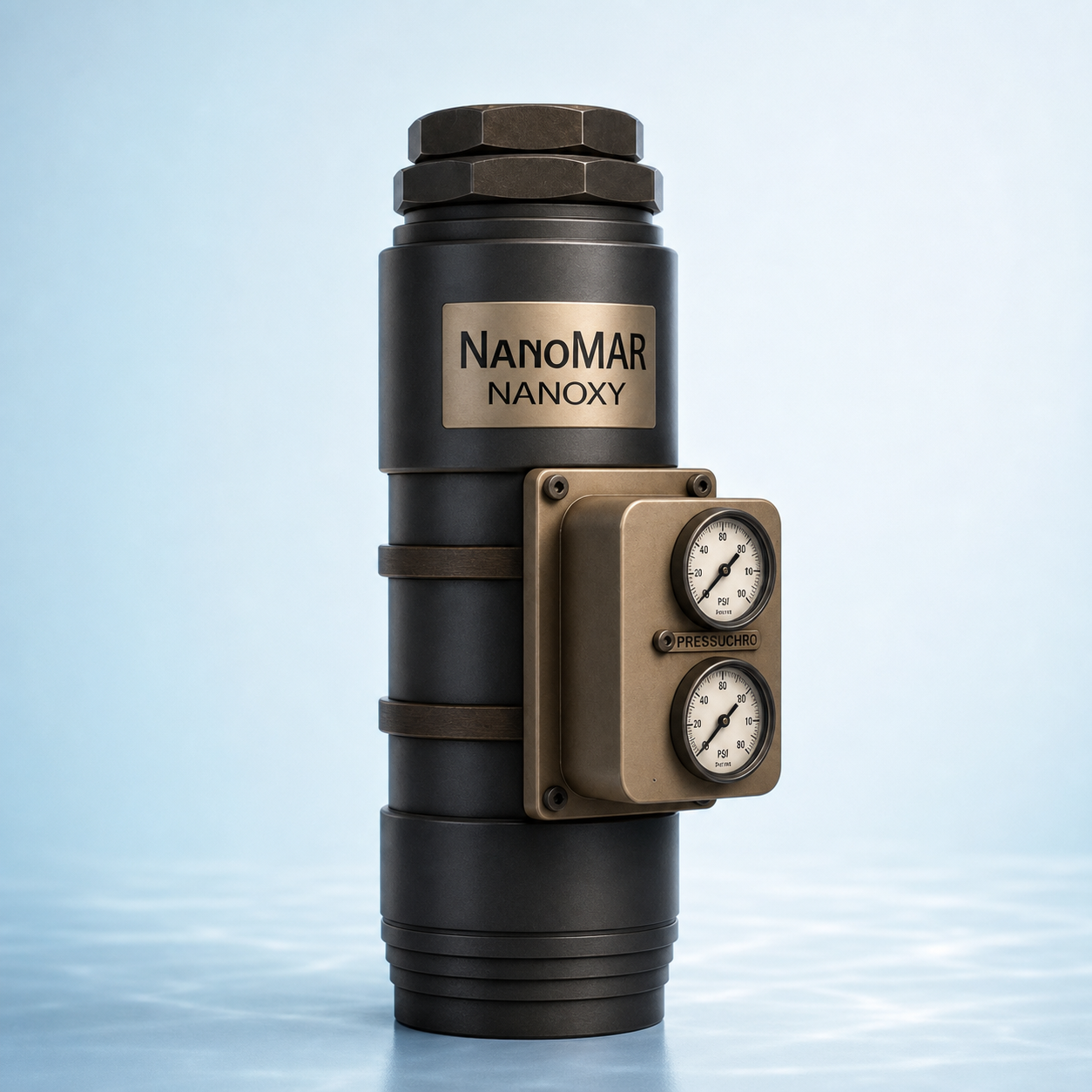
Gas choice is not cosmetic. A 2025 marine-RAS study in Fishes found that air nanobubbles raised the abundance of nitrifying bacteria and lowered nitrite — a biofilter effect rather than an oxygen one. The sizing arithmetic is just as blunt. The skid-mounted NanOxy Pro runs 18.9–75.6 m³/h, and the flow depends on the dose: 18.9 m³/h at 40 mg/L, 37.8 at 20 mg/L, 75.6 at 10 mg/L. Dose down, flow up. That trade is where sizing for nanobubbles in aquaculture and RAS begins; the generation stage comes after.
Where do nanobubbles fit inside a wastewater plant?
Three places, rarely all worth doing at once. In the biology the duty is oxygen transfer. In the water phase it is flotation, lifting suspended and organic load out before it becomes a downstream problem — what the NanVANN Pro is built around: TSS and TOC reduction with TAN management, 5–500 m³/h. In the sludge line the payoff is physical: denser sludge, fewer transports, a lower cost per cubic metre of dewatered mass. Less liquid to dewater, less mass to move.
One honest note, since it comes up in every wastewater aeration conversation. NanoMAR states lower energy operation and publishes no percentage behind it. Neither will this article. An energy saving quoted to two decimals for water nobody has seen came from somewhere other than your plant.
Can nanobubbles do anything for irrigation and greenhouse water?
Yes, and the duty is narrow enough to prove quickly. Oxygen at the root zone is the point — measured at the emitter, not in the header tank. Biofilm in drip lines is the second job: keep a line from fouling and distribution stays even — a yield question dressed as a plumbing one. Nothing accumulates in the emitters either, because nothing was added, which is the practical case for nanobubbles in irrigation water.
Why would a cooling tower run nanobubbles instead of a biocide?
The case is operational rather than dramatic: no chemical storage, handling or dosing equipment on site, and fewer cleaning cycles where biofilm is controlled. That is the whole claim. NanoMAR publishes no log-reduction figure and no health or drinking-water safety claim, so this article will not supply one. Cooling water is regulated, and the honest test is a pilot on your own — chemical-free cooling tower treatment is written with the same caveat.
What changes in flotation when the bubbles are nanoscale?
The fine fraction changes. Conventional flotation bubbles are coarse enough that fine particles slide past them; nanobubbles attach through zeta potential rather than by collision alone, so they reach material a larger bubble misses. The figures to hold a trial against in mining and mineral processing are 80 %+ suspended-matter removal and 50 %+ turbidity reduction. NanoMAR publishes no reagent-saving, recovery or yield percentage — treat any you are quoted as a hypothesis to test on your own ore.
What are nanobubbles used for in food and beverage water?
Surface cleaning and degreasing, mostly, plus wash-water duty with ozone as the gas. The attraction is the absence of a rinse problem: a physical process leaves no residue to chase. Duty in food and beverage water treatment is usually intermittent, which moves sizing from average flow to peak shift load.
Which of these is closest to your process?
| Industry | Job the nanobubbles do | Gas worth trying first | Number to agree first |
|---|---|---|---|
| Aquaculture and RAS | Oxygen transfer, fine-solids flotation, biofilm control | Oxygen; ozone to disinfect | DO at the biomass peak, not the daily mean |
| Municipal wastewater | Aeration, flotation, sludge and odour | Air or oxygen | TSS and TOC; sludge dryness |
| Irrigation and greenhouses | Root-zone oxygen, clean drip lines | Air or oxygen | DO at the emitter, not at the tank |
| Cooling towers, stored water | Biofilm control without dosing | Air; ozone where permitted | Cleaning interval; downtime hours |
| Mining and flotation | Fine-fraction capture | Air | Return-water turbidity; fines recovery |
| Food and beverage | Surface cleaning, degreasing, wash water | Ozone or air | Rinse-water quality and residue |
Three questions settle most of the rest:
- Which job is it? If two of the three apply, name the one that has to pay for the project.
- What does the worst hour look like? Flow and dose are sized on the peak, never the average.
- Where does the water go after the injection point? Contact time is part of the design, not a site detail.
Pick the measurement before you pick the machine. If nobody agrees which number has to move, no generator will settle the argument.
NanoMAR works across 9+ industries, and the six above are the ones whose duty fits in a sentence. Oil and gas, lakes and ponds and desalination pre-treatment sit on the industries we serve page, and what a trial measures is set out in how we prove results.
Frequently asked questions
How are nanobubbles used across industries?
NanoMAR's nanobubbles do three jobs in any sector: transferring gas into water, lifting suspended particles out of it through their negative zeta potential, and controlling biofilm on wetted surfaces. Aquaculture, wastewater, agriculture, mining and food production each lean on a different one of the three.
Which industries can use nanobubble water treatment?
NanoMAR applies nanobubble technology across 9+ industries: aquaculture, agriculture, wastewater, oil and gas, food production, mining, lakes and ponds, water towers and desalination. The deciding factor is the duty rather than the sector — whether the water needs more dissolved gas, fewer suspended particles, or a surface kept clear of biofilm.
Do nanobubble systems need chemicals in any industry?
No. Generating nanobubbles is a purely physical process, so NanoMAR systems dose no coagulant, surfactant or biocide in any application and leave no by-products or residues in the treated water. The only inputs are the water, the gas — oxygen, air or ozone — and the energy to run the unit.
In my own experience the hardest part of a technology that crosses industries is not the engineering. It is getting one number agreed. Most of my work has been RAS water quality and the design optimisation of recirculating systems, over six-plus years of international water-treatment projects, and I used to open every conversation with the platform — three stages, three gases, here is the flow range. I have stopped doing that. The pattern that changed my mind keeps repeating: oxygen and suspended solids both end up on the table, nobody says which one the decision rests on, and the review afterwards becomes two people reading different numbers at each other. That is a scope problem, not a machine problem. So the duller question comes first now — which measurement has to move, and who reads it. The industry label can wait.
If one of the six sections sounds like your process, a sizing conversation gets further than a datasheet: the flow, the duty, the gas you can get on site, the number you want to move. Send those four and we will work through the options with you.