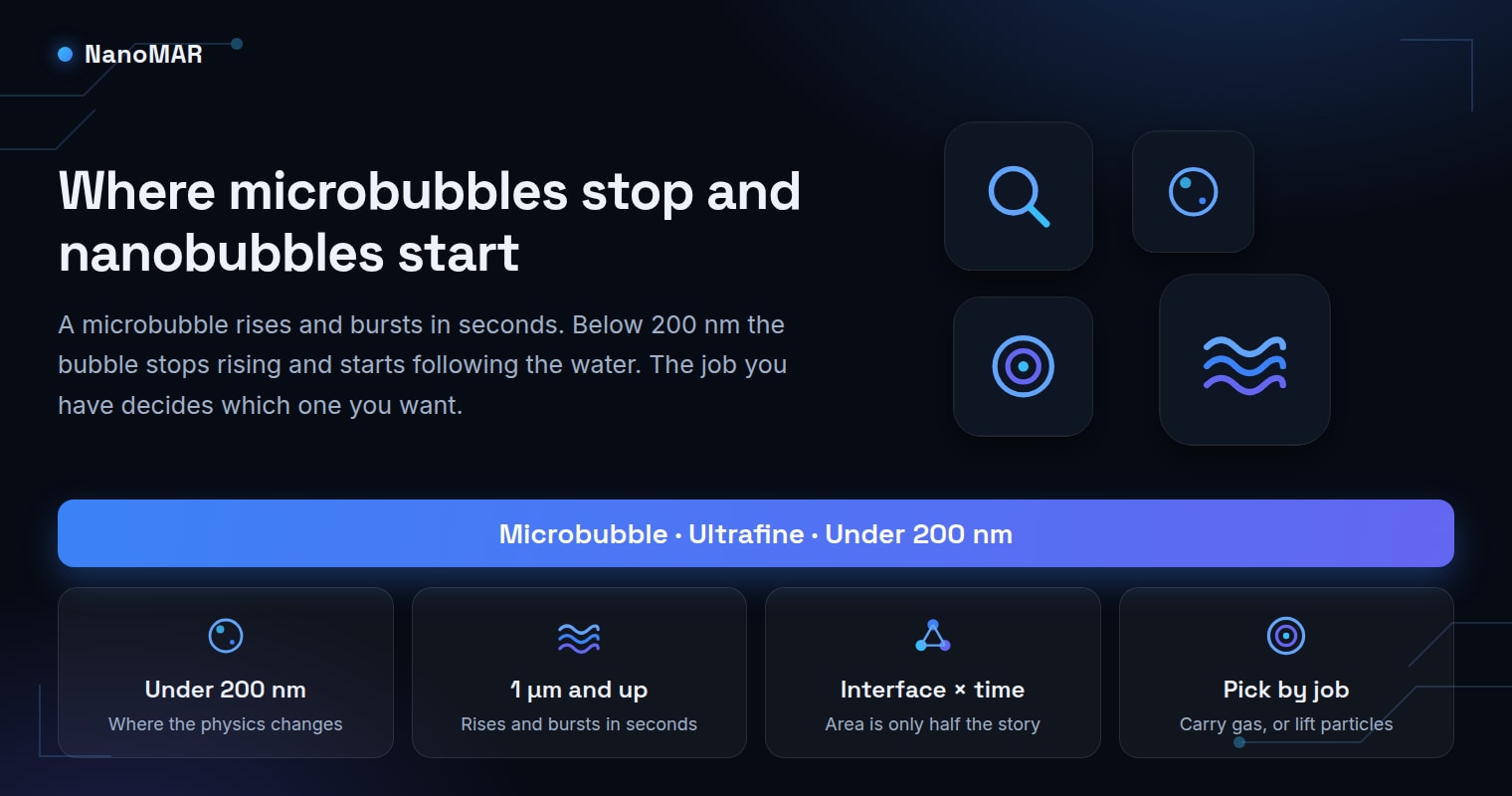
Put nanobubbles vs microbubbles side by side and only one variable really changes: size. A microbubble is measured in micrometres, rises through the water column and bursts at the surface within seconds. A nanobubble is a gas cavity under 200 nm — effectively neutrally buoyant, suspended for days to weeks, still working long after the pump that made it has stopped. One is a delivery van; the other is storage. Which you need depends on whether the job is to push gas into solution fast, or to keep a whole loop active between shifts.
Nanobubbles vs microbubbles: where does the size boundary sit?
The boundary is written down. ISO 20480-1:2017, the terminology standard for the field, treats every bubble below 100 µm as a fine bubble, then cuts that group in two at one micrometre: microbubbles above the line, ultrafine bubbles below it. The standard avoids the word "nanobubble" on purpose, because ISO's nanotechnology vocabulary reserves "nano" for 100 nm and under. NanoMAR specifies under 200 nm, well inside the ultrafine class.
That distinction is commercial, not just semantic. "Micro-nano bubble" is a marketing phrase rather than a size class, usually attached to equipment producing micrometre-scale bubbles with a thin tail of smaller ones. If a supplier will not hand over a size distribution, assume you are being quoted microbubbles. Our nanobubble glossary has the terms a specification should use instead.
| Microbubble | Nanobubble (NanoMAR) | |
|---|---|---|
| Diameter | 1 µm and above, inside the fine-bubble range below 100 µm | Under 200 nm |
| ISO 20480-1 class | Microbubble | Ultrafine bubble |
| Behaviour in water | Rises and bursts | Effectively neutrally buoyant; follows the water |
| Time in suspension | Seconds | Days to weeks |
| Surface charge | Not a working mechanism at this size | Strong negative zeta potential |
| Gas transfer | Limited by how long the bubble survives | Near-complete, from an enormous combined gas–liquid interface |
| What the water looks like | Visibly milky while dosing | Unchanged to the eye |
| Suits | Fast aeration where off-gassing is acceptable | Oxygenation that must hold, contaminant lift, ozone without off-gassing |
Why does a microbubble rise while a nanobubble stays suspended?
Buoyancy is a volume effect; drag is not. Shrink a bubble far enough and the upward push falls away faster than the resistance of the water around it, until the bubble simply goes wherever the water goes. Below 200 nm that is what happens — a NanoMAR nanobubble is effectively neutrally buoyant and stays in suspension for days to weeks, where a coarse bubble has already risen and burst. The strong negative zeta potential on each nanobubble does the rest, keeping neighbours from merging into something big enough to float away. That same surface charge has a second job. It lifts suspended matter and contaminants off surfaces, instead of merely moving gas about.
Here is the part the datasheets skip. Classical theory says none of this should work. Epstein–Plesset dissolution maths predicts that a gas bubble of 100 to 200 nm in diameter should completely dissolve in under a millisecond. It does not. Yasui's 2022 review in Nanomaterials records ultrafine bubbles surviving more than nine months in an airtight glass bottle, with no gas–liquid interface anywhere in the system. The explanation is still contested; the observation is not. You specify against measured persistence, not against whichever stability model eventually wins.
What does the smaller bubble buy you in oxygen transfer efficiency?
Break one bubble into a population of much smaller ones and the gas inventory is unchanged, but the interface across which that gas can dissolve grows enormously. That combined gas–liquid interface is what drives near-complete gas transfer instead of gas escaping at the surface, and it is why NanoMAR publishes 40 %+ higher oxygen transfer than conventional methods.
Time is the factor people leave out. A microbubble's interface exists for seconds; a nanobubble's exists for days to weeks. The honest comparison is interface area multiplied by the time that interface stays available — which is also why nanobubbles move readings at the far end of a recirculating loop, rather than at the injection point alone.
If a diffuser already holds your dissolved-oxygen target with margin through the worst hour of the day, bubble size is not your problem and you should not be buying a new one.
Which bubble size suits which job?
Work down this list in order. The first line that describes your water usually settles it.
- Raise dissolved oxygen fast, short contact path, off-gassing acceptable — conventional fine-bubble aeration is adequate, and most plants already have it.
- Hold a dissolved-oxygen target across a whole recirculation loop, overnight and at peak feeding — that needs persistence, so nanobubbles under 200 nm.
- Lift suspended solids or clean a surface without dosing anything — only the charged route does this. NanoMAR publishes 80 %+ suspended-matter removal and 50 %+ turbidity reduction, with zero chemicals added.
- Deliver ozone where it has to stay in the water — ozone in coarse bubbles largely leaves at the surface; as nanobubbles it stays in contact, and nothing is dosed, so there are no by-products or residues.
- Remove a chemical line from the site — no storage, no handling, no dosing equipment, with bubble size as the mechanism that replaces it.
Where the answer is nanobubbles, the generation stage is a separate decision — membrane, venturi or ceramic, running oxygen, air or ozone. How the patented platform forms and holds them is worth reading before you shortlist equipment.
What goes wrong when the bubble size is wrong for the job?
- Paying for gas that leaves at the surface. Oxygen or ozone dosed as coarse bubbles in a shallow tank off-gasses before it dissolves. The gas bill reflects the dose. The probe does not.
- Turbidity that never moves. A plant buys bubbles to clear its water, gets microbubbles, and the solids stay put — without a strong negative surface charge nothing lifts a particle.
- Measuring at the injector. Persistence only earns its keep when it is measured where the water is actually used, hours after dosing. A reading beside the generator proves the generator runs.
- Chemicals quietly coming back. When bubble size cannot do the job, a dosing line gets reinstated, and the chemical-free case the project was approved on disappears.
Frequently asked questions
What is the difference between nanobubbles and microbubbles?
Size, and everything that follows from it. A microbubble is one micrometre or larger, and it rises to burst at the surface within seconds. A NanoMAR nanobubble is a gas cavity under 200 nm. It is effectively neutrally buoyant and stays suspended in the water for days to weeks. ISO 20480-1 classes the second group as ultrafine bubbles.
Are nanobubbles better than microbubbles?
For any job that depends on gas staying in the water, yes. Nanobubbles give NanoMAR systems 40 %+ higher oxygen transfer than conventional methods, and their strong negative zeta potential lifts contaminants in a way microbubbles cannot. Where a simple diffuser already holds the oxygen target, nanobubbles are not needed.
Which bubble size gives the best oxygen transfer in water?
The smaller the bubble, the larger the combined gas–liquid interface and the longer it survives to be used. NanoMAR generates nanobubbles under 200 nm for that reason: the enormous interface across a whole population drives near-complete gas transfer, rather than gas rising out of the tank before it dissolves.
I had this argument backwards for a while. My own work has been RAS water quality and design optimisation of recirculating systems, and early on I treated bubble size as a procurement question — get the distribution under 200 nm, tick the box, move on. On one project I worked on myself the distribution was right and the morning numbers still disappointed everyone in the room. The sampling point was the problem. We were reading the water just past the injection stage, which proved the generator worked and said nothing about whether the oxygen was still there at six in the morning. Moving the probe downstream changed the conversation in an afternoon. It also cost us contact volume nobody had planned to give up, and I would make that trade again. The size spec is the easy half. Deciding where you stand and look at the number is the half that settles whether anyone believes you.
If you are weighing bubble size against your own water, the physics sits in our guide to what nanobubbles are. Send the flow, the gas and the dissolved-oxygen target you need to hold, and we will work through whether size is actually your constraint.