
A nanobubble generator has one job: dissolve gas into water as bubbles under 200 nm and hold them there long enough to work. Which one you need is settled by three numbers on your side of the flange — the flow you treat, the dose that flow needs in milligrams per litre, and whether the duty is continuous or a trial. Membrane or venturi, skid or portable, oxygen or ozone follow from those three. NanoMAR, in Bergen, builds five models around that arithmetic.
What does a nanobubble generator actually have to do on your site?
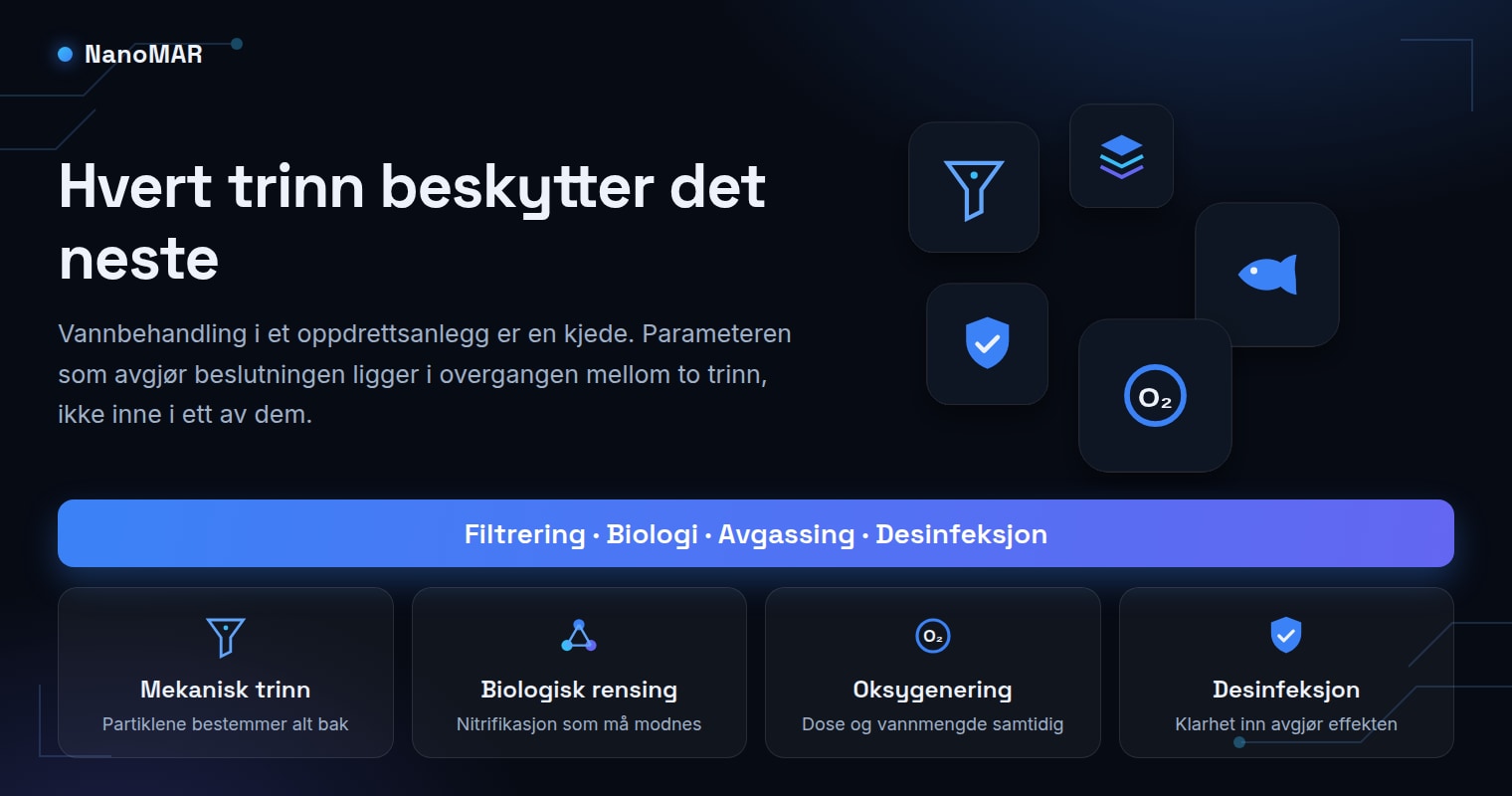
Four stages, in order: intake and gas dosing, nanobubble generation, diffusion and contact, cleaner water out. Only the middle two are the machine. The first and the last are your pipework, and that is where integration surprises live.
A coarse bubble rises and bursts in seconds. A nanobubble — a gas-filled cavity under 200 nm — is effectively neutrally buoyant and stays suspended for days to weeks, so contact time stops being something you buy with tank depth. The gas–liquid interface becomes enormous, driving near-complete gas transfer, and the bubbles carry a strong negative zeta potential: the charge that attaches them to suspended matter and lifts it out of the column.
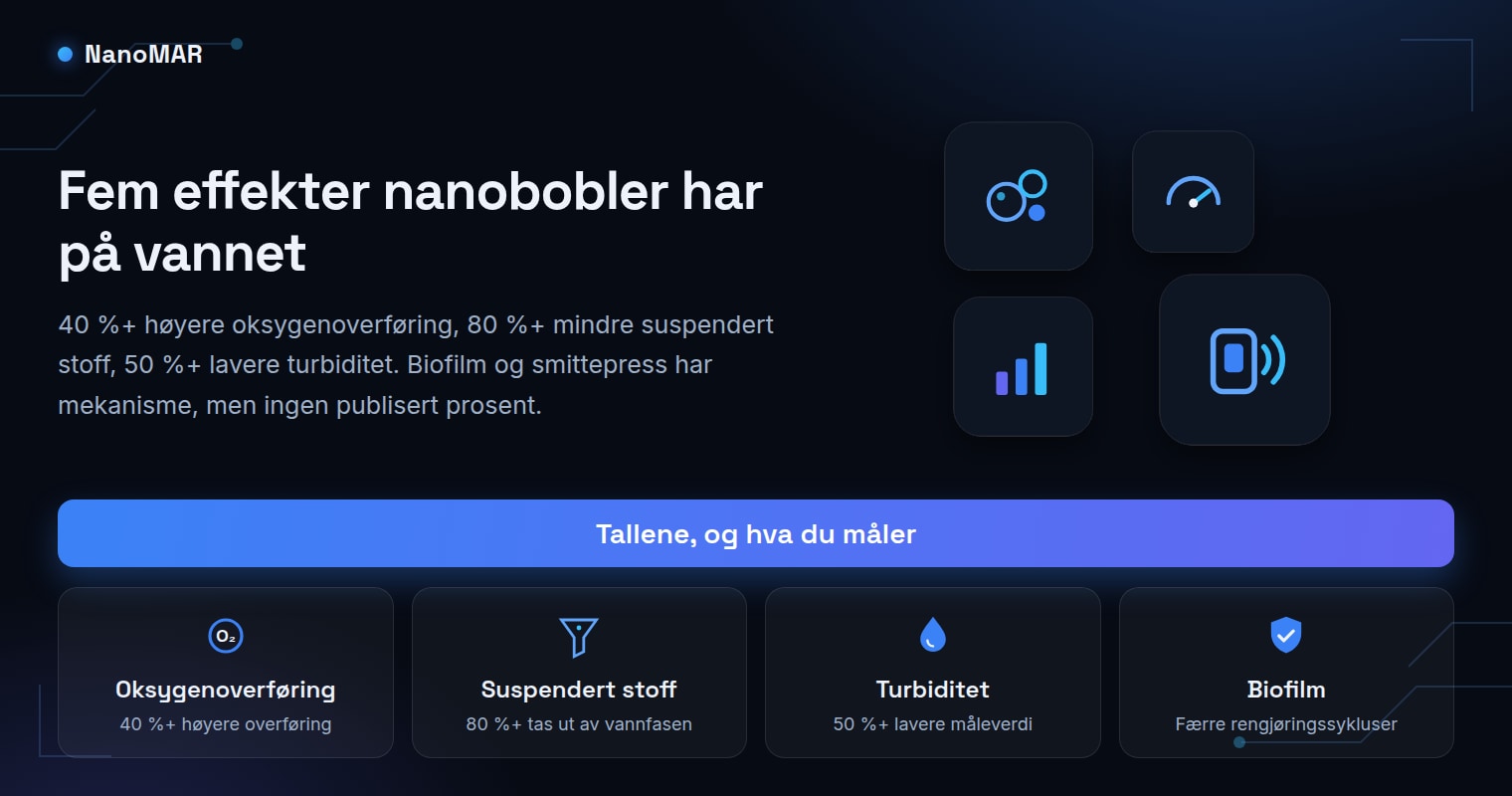
NanoMAR's published figures on its patented platform: 40 %+ higher oxygen transfer, 80 %+ suspended-matter removal, 50 %+ turbidity reduction, nothing dosed and no by-products or residues. Dissolved oxygen (DO) is usually the parameter the duty hangs on, and the US EPA factsheet on dissolved oxygen sets out why it is the number aquatic life is judged against.
Membrane, venturi or ceramic — which stage belongs in your line?
NanoMAR runs all three separation technologies on one platform, which changes the question from "whose method is best" — a supplier with one method always answers that the same way — to "which stage suits this water". The mechanics of each are in our guide to how nanobubbles are generated.
What catches buyers out is a services question rather than a physics one. The NanOxy S1 is a membrane platform: it needs a compressed-gas supply, and there is no electrical connection at the membrane module itself. If the injection point sits where you would rather not run power, raise that in the first meeting, not the last.
How do you size a nanobubble generator instead of guessing?
Five answers turn an enquiry into a specification, in the order they change the machine:
- The worst hour, not the daily average. Feeding peak, summer temperature, a filter in backwash. Size for the average and the unit is short in exactly the hour that matters.
- The dose, in mg/L. Flow alone specifies nothing. Flow and dose together specify a model.
- The gas. Oxygen, air or ozone — and what you can realistically get on site.
- Where it injects. Contact volume downstream, and what the water does between injection and the measuring point.
- Site services. Gas, power, footprint, weight. The skid-mounted NanOxy Pro is approximately 200 kg — a crane question, not a catalogue one.
Dose and flow trade directly, and the NanOxy Pro shows it plainly: 18.9 m³/h at 40 mg/L, 37.8 m³/h at 20 mg/L, 75.6 m³/h at 10 mg/L. One machine, three answers to "what flow does it do?". Our sizing and oxygen-transfer calculator gets you a first estimate before anyone picks up the phone.
Should the generator run oxygen, air or ozone?
Oxygen when DO is the binding constraint — the usual case in a recirculating aquaculture system (RAS) at peak biomass. Air when the duty is aeration and mixing rather than a saturation target. Ozone for disinfection, pathogen control or biofilm, with the materials selection and off-gas handling that brings. Gas choice changes wetted materials, site services and often the model, so it belongs in the specification, not the commissioning notes.
What should you ask a supplier about energy per kilogram of oxygen?
Ask for kilograms of oxygen delivered per kilowatt-hour, at your duty point, on your water. It separates suppliers faster than any brochure comparison: standard efficiency figures are measured in clean water, oxygen stripped out first. Your tank has biology, solids and often salinity in it, and each pushes the real figure away from that one.
NanoMAR does not publish an energy percentage. The platform runs at lower energy, and the honest comparison is measured on your water — not lifted from a datasheet that was never about your process.
Which NanOxy model matches which duty?
| Model | Flow | Where it fits |
|---|---|---|
| NanOxy S1 | 0.3–1 000 m³/h | Membrane platform, laboratory research to full industrial installations. Compressed gas required; no electrical connection at the membrane module |
| NanOxy S2 | 2–50 lpm | Portable membrane unit for oxygenation trials and repeatable R&D validation |
| NanOxy Pro | 18.9–75.6 m³/h | Skid-mounted continuous aquaculture duty; approximately 200 kg |
| NanOxy M Pro | 10–100 m³/h (nominal 35–55) | Compact pilot platform for process validation and scale-up planning |
| NanVANN Pro | 5–500 m³/h | Complete wastewater unit: TSS and TOC reduction, TAN management |
Two misreadings are worth naming. The platform tops out at 1 000 m³/h on the S1 — 500 m³/h is the NanVANN Pro's ceiling, not the range's. And the S2 is a trials unit; buying one for production duty because the flow looked close gets reversed at the second peak. The full NanOxy range sets the models side by side.
What actually drives the cost of a nanobubble generator?
NanoMAR publishes no price list, for a structural reason rather than a commercial one: the same flow rate can mean two different machines depending on dose, gas and water chemistry. What moves the number, roughly in order:
- The duty point — flow multiplied by dose, at the worst hour.
- The gas and how it arrives — delivered, stored or generated on site.
- Water and materials — seawater or fresh, ozone service or not.
- Duty cycle — a production skid and a pilot platform are not the same purchase.
- Integration — injection point, footprint, controls, how much pipework moves.
Against those sit the things that leave the site: no chemical storage, handling or dosing equipment, lower energy operation, and — where flotation does the work — denser sludge, meaning fewer transports and a lower cost per cubic metre of dewatered mass. Our page on what a nanobubble system costs sets out the same variables.
How do you tell a nanobubble manufacturer from a reseller?
Search for a nanobubble generator for sale and the first page is largely distributors. No reason to avoid them, but it changes what you ask, because a reseller cannot answer half of it:
- Who holds the patent on the generation technology?
- Can they walk all four process stages for your line, not a generic diagram?
- Is there more than one generation technology to choose from, or one method that apparently suits everything?
- What measurement sits behind any bubble-size claim? ISO 20480-1:2017 exists so those claims can be compared.
- Will they pilot on your water, and name in advance which measurement decides whether it worked?
A bubble count with no method behind it is marketing; a supplier who asks for your worst hour before quoting is doing engineering.
Frequently asked questions
What is a nanobubble generator and what does it do?
A nanobubble generator forces gas — oxygen, air or ozone — into water as bubbles under 200 nm. NanoMAR's nanobubble generators use a membrane, venturi or ceramic stage to do it, raising dissolved oxygen and lifting suspended matter out of the water without dosing any chemical.
How do you size a nanobubble generator?
Size it on flow and dose together at the worst hour of the day, never on an average flow. NanoMAR sizes its nanobubble generators from the duty point, the gas available on site and the injection geometry, because one model delivers different flows at different doses.
How much does a nanobubble generator cost?
NanoMAR publishes no price list for its nanobubble generators, because cost follows the duty point, the gas supply, the wetted materials and the integration work rather than a catalogue line. A sizing conversation about your flow, dose and water answers it better than a headline figure.
What I learned the hard way is that a specification usually arrives with one number in it. A flow rate. Averaged over a day, sent in good faith, and almost useless on its own. For a long stretch of my six-plus years on international water-treatment projects I took it at face value, sized from it, and then watched the peak hour do something the average never hinted at. I work on RAS water quality — the design optimisation of recirculating systems — and the gap I keep running into is the one between a dissolved-oxygen figure on a datasheet and what a probe in a working tank reads at feeding. I had assumed that gap was a measurement problem. It is not — it is a sizing question asked at the wrong hour. So now I ask for the worst hour first, and where the probe is mounted. Duller question. Better machine.
If you have a flow, a dose and a gas you can get on site, that is enough to start. Send those three and we will work through which model fits.